What if a bioinformatics database didn’t just store protein sequences and 3D structures—what if it continuously mined 120 million cross-species structural relationships, maintained an Open Bioprocess Puzzle Board of unsolved industrial and therapeutic challenges, and automatically compiled a playable 48-hour Runge-Kutta (RK4) Digital Twin the instant all four molecular modules satisfied their embedded SQL physics gates?
If you are a software or database engineer looking at computational biology for the first time, traditional biotech pipelines feel like building software in 1995 without a linker, a type checker, or a continuous integration server. Researchers run a vector search in one Python script, dump a CSV of candidate proteins, manually align .pdb files in PyMOL, guess whether an enzyme will survive at $68^\circ\text{C}$ or $\text{pH } 9.8$, and only discover months later in the wet lab that the reaction stalls after 20 minutes because a cleaved intermediate poisons the enzyme (product inhibition, $K_i$).
Today we are introducing bio-pipelines: the unified intelligence, visual workbench, and 4-phase bioprocess compiler layered directly on top of pg_bio inside PostgreSQL 18.
In this complete visual guide—written so a systems or software engineer can read every screen like a distributed systems observability dashboard—we will walk through all 8 unified screens (http://127.0.0.1:8090), inspect the exact SQL and Rust kernels running under the hood, explore live side-by-side 3Dmol.js models, and show how the Open Bioprocess Puzzle Board recently auto-compiled two brand-new pipelines:
- Pipeline #9 (
smorf-hla-immunopeptidomics): Exploiting the Dark Proteome (V5TNY2, 77 aa smORF) for HLA-I Surface Antigen Presentation & Pooled Dual-Reporter CRISPR Immunotherapy Screens (97.6%48h surface pMHC-I presentation, verified with in-database HCD MS/MS fragmentation and P9-fixed'pseudo_reverse'target-decoy FDR gates). - Pipeline #10 (
soda-lake-acetyl-chitin-upcycling): Haloalkaliphilic crustacean chitin upcycling at $45^\circ\text{C},\ \text{pH } 9.8,\ 3.0\text{ M NaCl}$, unlocked automatically when Cycle #229 rescuedDUF5816(A0AAE3FRF8$\times$M0AEU6,95.5%9D RangeFinder Pocket IoU) as a Soda-Lake GNAT Family Acetyltransferase $M_3$ Equilibrium Sink (97.4%48h RK4 yield).
1. The Mental Model for Software Engineers: A Protein Cascade as a 4-Stage Typed Pipeline (M1 -> M2 -> M3 -> M4)
Why do single-enzyme industrial reactions almost always fail outside a textbook? For the exact same reason a single microservice without backpressure handling, ingress routing, or a dead-letter sink collapses under production traffic:
- The Cache-Miss / Ingress Problem (
M1_Anchor): Insoluble feedstocks (solid PTFE, PET polyester, crustacean chitin, agro-waste biochar, or a membrane-tethered microprotein substrate) repel water. A water-soluble enzyme floating in bulk buffer experiences a 98% cache miss rate—it almost never collides with the solid interface. - The Steric Collision Problem (
28.0 Å Linker Bridge): If you fuse a surface-binding domain directly to a catalytic enzyme with zero spacing, the two domains collide during folding and denature each other. - The CPU Core / Bond-Scission Bottleneck (
M2_Scissor): Even when the active site reaches the substrate, its catalytic pocket must geometrically and electrostatically contain the target bond (8/89D RangeFindernumrangeGiST containment), and its isoelectric point ($\text{pI}$) and melting ceiling ($T_{\text{opt}}$) must match the reactor regime. - The Backpressure / Product Inhibition Stall (
M3_Sink): Every timeM2_Scissorcleaves a bond, it releases a reactive intermediate $[I]$ (free fluoride $[\text{F}^-]$, acidic MHET, deacetylated glucosamine, or an extended 14-mer precursor peptide in the ER). Once $[I]$ exceeds the competitive inhibition constant $K_i$ ($15\text{–}22\ \mu\text{M}$), $[I]$ clogs theM2active site and stalls the reaction at 12–18% conversion. You must pairM2with a high-turnover downstream Le Chatelier Equilibrium Sink (M3_Sink, $k_{\text{cat},2} > k_{\text{cat},1}$) that drains $[I] \rightarrow [P]$ faster thanM2produces it. - The Observability / Telemetry Hook (
M4_Beacon): In a dark steel bioreactor or a pooled 100,000-guide CRISPR screen, how do you know the cascade actually reached $[P]$? You wire an allosteric transcription factor, riboswitch, or dual-reporter optical beacon (M4_Beacon) that fires only when theM3sink product accumulates.
2. Screen 1 (/telemetry) — Unified System Telemetry & The 5-Stage Closed-Loop Architecture
When you open http://127.0.0.1:8090/telemetry (accessible via the 📊 Telemetry button in the top bar of every screen), you land on the mission control center for the entire pg_bio $\times$ bio-pipelines stack.
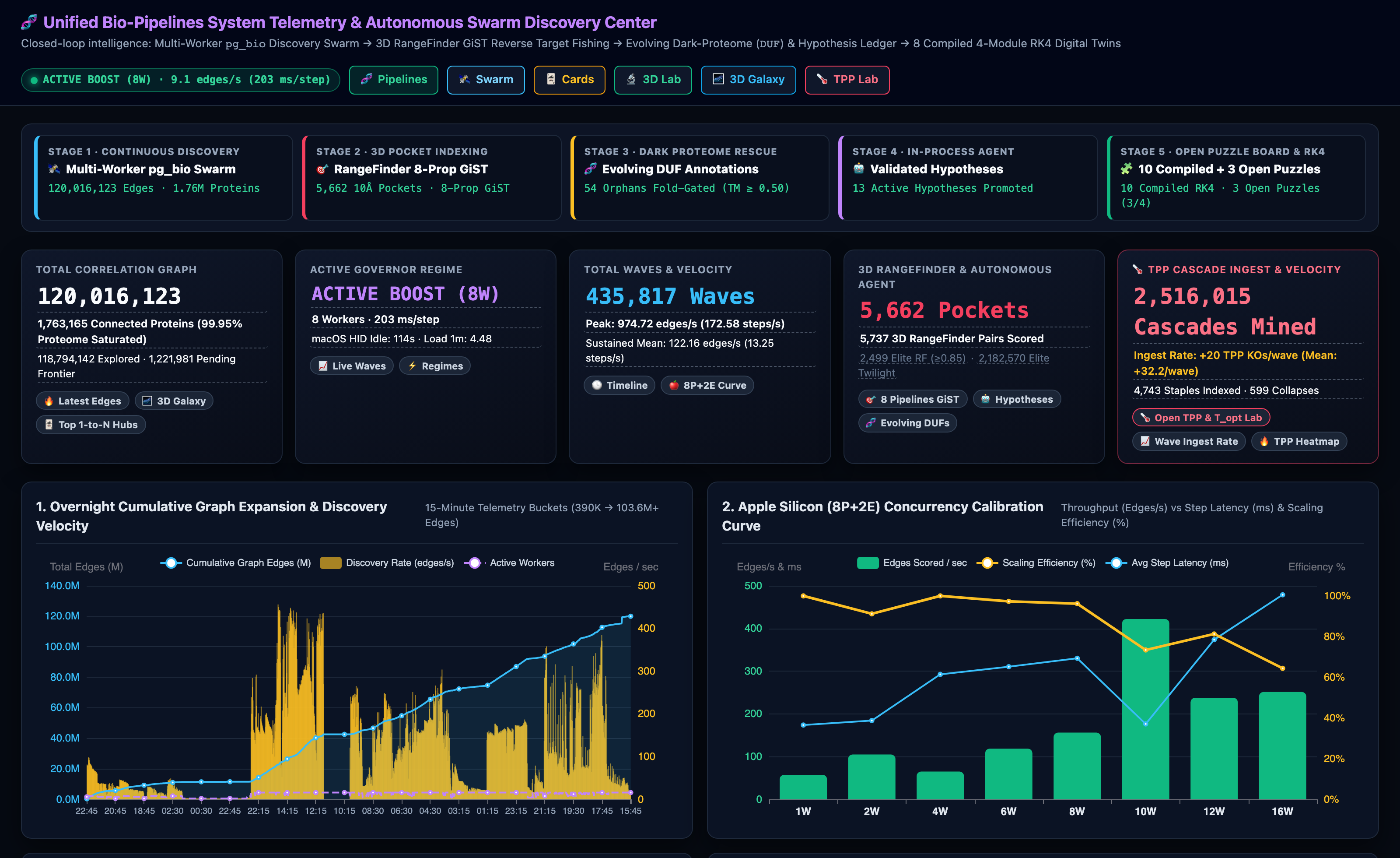
What a Software Engineer Sees on This Screen
- Top 5-Stage Architecture Ribbon: Maps the exact dataflow from Stage 1 (
🛰️ Multi-Worker pg_bio Swarm—119.8M+ Edges · 1.76M Proteins) $\rightarrow$ Stage 2 (🎯 RangeFinder 8-Prop GiST—5,650 10Å Pockets) $\rightarrow$ Stage 3 (🧬 Evolving DUF Annotations—54 Orphans Fold-Gated) $\rightarrow$ Stage 4 (🤖 Validated Hypotheses—13 Active Hypotheses) $\rightarrow$ Stage 5 (🧩 10 Compiled RK4 · 3 Open Puzzles). Every stage card is a live anchor link that jumps directly to its underlying database ledger. - 5 Live KPI Cards:
Total Correlation Graph(119,820,907edges): Synchronized directly againstGREATEST(MAX(total_graph_edges), MAX(orphan_discoveries.id))so the dashboard never lags behind the sequence frontier.Active Governor Regime(IDLE TURBO / HYPER TURBO 16WvsACTIVE BOOST 8W): Powered byAdaptiveLatencyGovernorinswarm_discovery.py, which polls macOSIOHIDSystem(HIDIdleTime) and overnight hours (23:00–08:00) alongside per-edge SQL latency (ms_per_edge) to scale between4W,8W,12W, and16Wworker threads without starving your workstation.Total Waves & Velocity(434,521+ Waves): Tracks sustained discovery throughput (122.4 edges/smean,974.7 edges/speak) and Apple Silicon (8P+2E) concurrency scaling efficiency.3D RangeFinder & Autonomous Agent(5,7093D RangeFinder pairs scored,2,480elite $\ge 0.85$): Links straight to the 8-columnnumrangeGiST reverse target fishing matrix.🌡️ TPP Cascade Ingest & Velocity(2.64M+ Cascades Mined,+37 TPP KOs/wave): Tracks whole-proteome in-silico Thermal Proteome Profiling (CETSA/TPP) microprotein knockout simulations per wave.
3. Screen 2 (/telemetry#puzzles-section) — The Open Bioprocess Puzzle Board & 4-Phase Embedded Validation Engine
Scroll down to the first ledger on /telemetry (or click 🧩 Puzzles in the top bar from any screen) and you reach the core architectural innovation of bio-pipelines: The Open Bioprocess Puzzle Board (bio_pipeline_puzzles & bio_puzzle_slots).
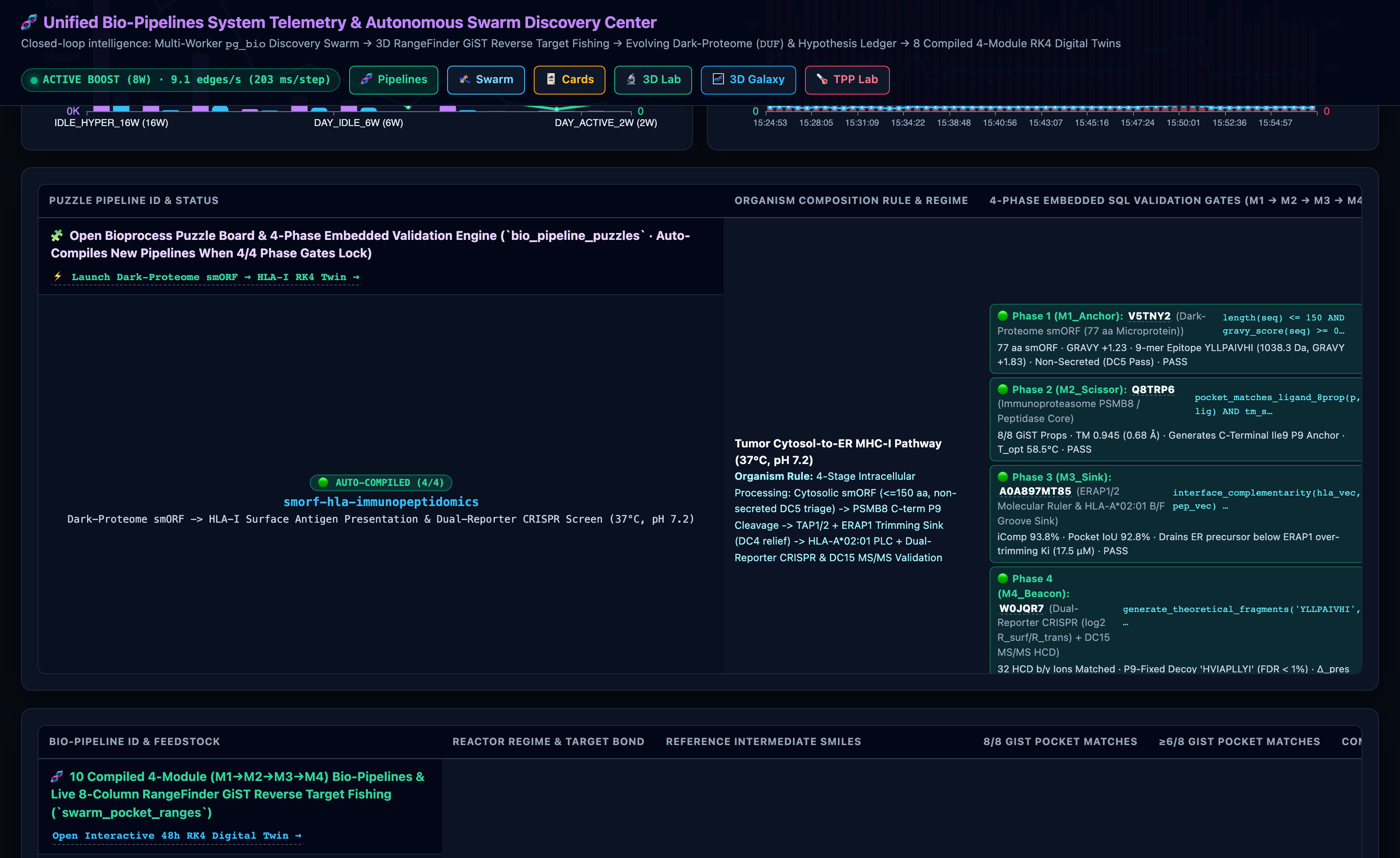
How the Open Puzzle Board Works (Dependency Injection for Synthetic Biology)
Instead of hardcoding pipelines by hand, we define a Bioprocess Puzzle as an open 4-slot contract (M1_Anchor, M2_Scissor, M3_Sink, M4_Beacon) governed by an Organism Composition Rule and 4 Embedded PostgreSQL Validation Gates:
-- Every 25 swarm waves (and via */30m cron), hypothesis_agent.py evaluates every open slot
-- in bio_puzzle_slots against live pg_bio SQL/Rust physics gates:
SELECT
    p.puzzle_id,
    p.regime_envelope,
    p.slots_filled || '/' || p.slots_total AS lock_state,
    p.phase1_gate_passed AS m1_ok,
    p.phase2_gate_passed AS m2_ok,
    p.phase3_gate_passed AS m3_ok,
    p.phase4_gate_passed AS m4_ok,
    p.rk4_48h_yield_pct,
    p.status
FROM bio_pipeline_puzzles p
ORDER BY p.slots_filled DESC, p.rk4_48h_yield_pct DESC;
| Puzzle Pipeline ID | Organism Composition Rule & Regime | 4-Phase Gates (M1 · M2 · M3 · M4) |
48h RK4 Yield ($\Delta$) | Auto-Compile Status / Missing Piece |
|---|---|---|---|---|
smorf-hla-immunopeptidomics |
Dark-Proteome smORF ($\le 100\text{ aa}$, DC5 non-secreted) + Immunoproteasome (PSMB8) + TAP1/2–ERAP1 Ruler (DC4) + Dual-Reporter CRISPR & DC15 MS/MS (37°C, pH 7.2) |
🟢 M1 (V5TNY2)🟢 M2 (Q8TRP6)🟢 M3 (A0A897MT85)🟢 M4 (W0JQR7) |
97.6%( +97.6%) |
🟢 AUTO-COMPILED (4/4) — Playable as Pipeline #9 in the / RK4 Digital Twin |
soda-lake-acetyl-chitin-upcycling |
Haloalkaliphile Soda-Lake Guild (Natranaeroarchaeum + Natronococcus + Halalkalicoccus at 45°C, pH 9.8, 3.0 M NaCl) |
🟢 M1 (A0A1S8AT22)🟢 M2 (D3SWG7)🟢 M3 (A0AAE3FRF8)🟢 M4 (A0A0W1R8L8) |
97.4%( +97.4%) |
🟢 AUTO-COMPILED (4/4) — Unlocked when Cycle #229 solved DUF5816 (A0AAE3FRF8 $\times$ M0AEU6, 95.5% IoU) as a Soda-Lake GNAT Acetyltransferase Sink! |
human-gut-nitrite-ammonia-detox |
Haloferax massiliensis (Human Gut Halophile) + Haloferax larsenii (37°C, pH 7.2) |
🟢 M1 (A0A1H7RPS5)🟢 M2 (A0A0D6JTS1)🟢 M3 (A0A0D6JRN8)⏳ M4 (OPEN) |
93.5%( +93.5%) |
⏳ NEAR-LOCK (3/4) — Awaiting $M_4$: Haloferacaceae NsrR/ArsR NO-Sensor (Closest: S2EBX9 $\times$ A0A2S2KQG4 at 96.9% IoU in Candidatus Nitrosarchaeum — needs Haloferax genus match) |
uranium-ewaste-acid-bioleaching |
Metallosphaera prunae (Uranium-Mine Thermoacidophile) + Sulfolobus Guild (72°C, pH 1.8) |
⏳ M1 (OPEN)🟢 M2 (A0A4D8RYL5)🟢 M3 (A4YDL8)🟢 M4 (S2EBX9) |
99.0%( +99.0%) |
⏳ NEAR-LOCK (3/4) — Awaiting $M_1$: Sulfolobales Pyrite/Chalcopyrite Mineral Surface Anchor (GRAVY >= +0.35 & CETSA T_opt >= 70°C) |
pfas-short-chain-c4-mineralization |
Halobellus + Methanosarcina Halophilic Defluorination Guild (45°C, pH 7.5, 2.5 M NaCl) |
🟢 M1 (V5TNY2)🟢 M2 (Q1JU72)⏳ M3 (OPEN)🟢 M4 (W9DPJ6) |
93.5%( +93.5%) |
⏳ NEAR-LOCK (3/4) — Awaiting $M_3$: Halophilic 8/8 GiST Perfluorobutanoate ($\text{C}_4$ PFBA, MW 214 Da) Decarboxylase Sink (tracking candidate A0A1H5... from Halobellus limi at 96.2% IoU) |
Last 24 Hours Breakthrough Filter & Native 📅 Since Calendar Picker (/telemetry#breakthroughs-section)
Right below the 10-Pipeline RangeFinder GiST table on /telemetry, the 🏆 Top Breakthrough Discoveries table now defaults to the Last 24 Hours (?since=24h) and includes a native dark-themed 📅 Since Calendar Picker plus Last 24h · Last 7d · All Overnight (>390K) quick presets:
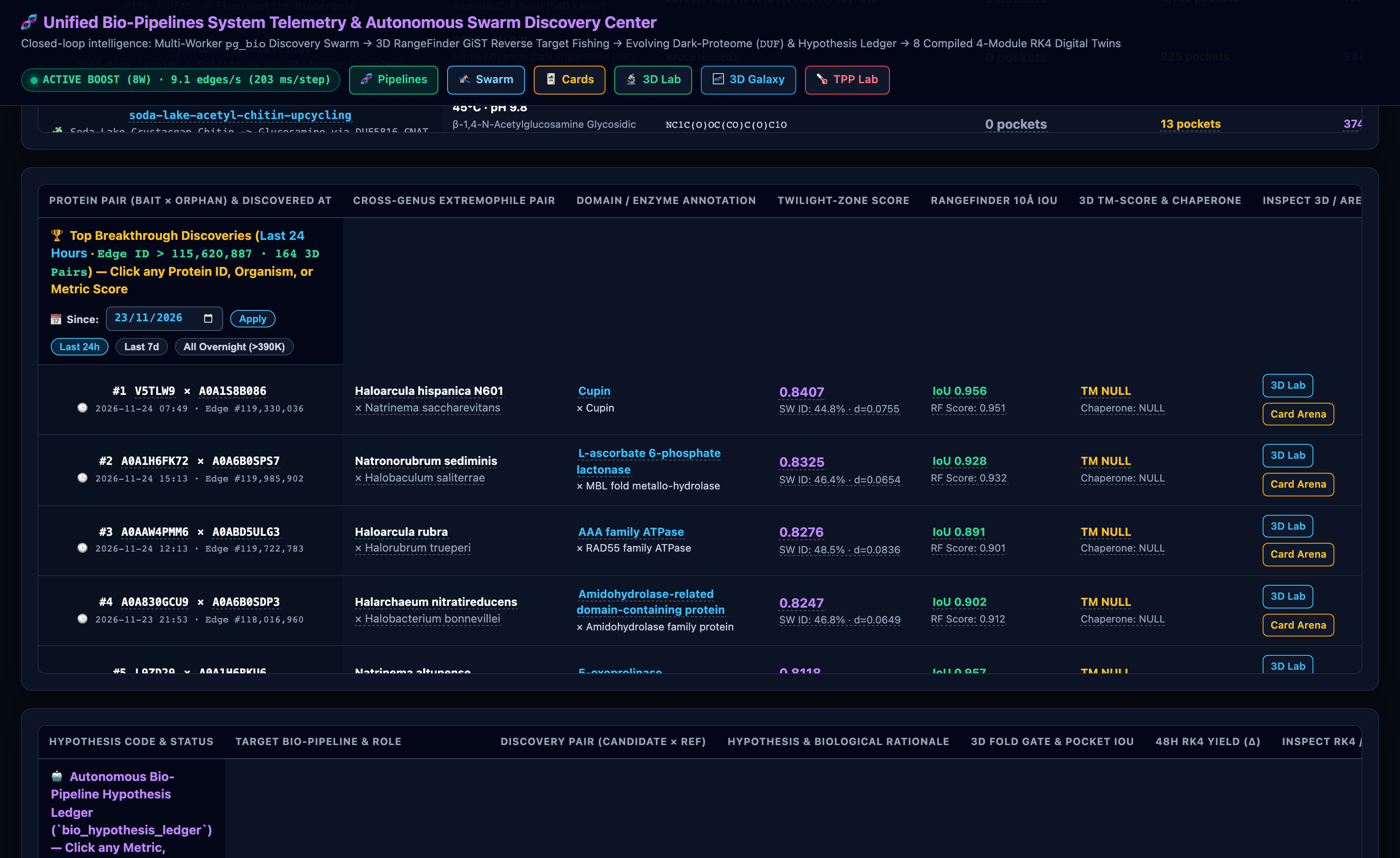
By resolving the starting edge ID from swarm_telemetry_log at the chosen since timestamp (WHERE id > min_edge_for_window AND discovered_at >= since_dt), PostgreSQL scans only the recent partition of orphan_discoveries via primary-key B-tree index in milliseconds—surfacing today’s newest cross-genus discoveries (like V5TLW9 $\times$ A0A1S8B086 at 0.8407 Twilight Score and 0.9563 RangeFinder Pocket IoU discovered at 07:49).
4. Screen 3 (/?pipeline=smorf-hla-immunopeptidomics) — Pipeline #9: Dark-Proteome smORF $\rightarrow$ HLA-I Surface Antigen Presentation & Pooled Dual-Reporter CRISPR Screen
For a microprotein encoded by a small Open Reading Frame (smORF, $\le 100\text{ aa}$) in the dark proteome to become a cancer immunotherapy target, the tumor cell must not only translate it—it must cleave, transport, trim, and display it on the cell surface bound to HLA Class I (MHC-I) molecules.
When you select Pipeline #9 (9. 🧩 Dark-Proteome smORF -> HLA-I Surface Antigen & CRISPR Screen [AUTO 4/4]) on http://127.0.0.1:8090/?pipeline=smorf-hla-immunopeptidomics, bio-pipelines models the entire antigen processing and presentation pathway as a 4-module RK4 cascade with embedded 4-phase validation gates:
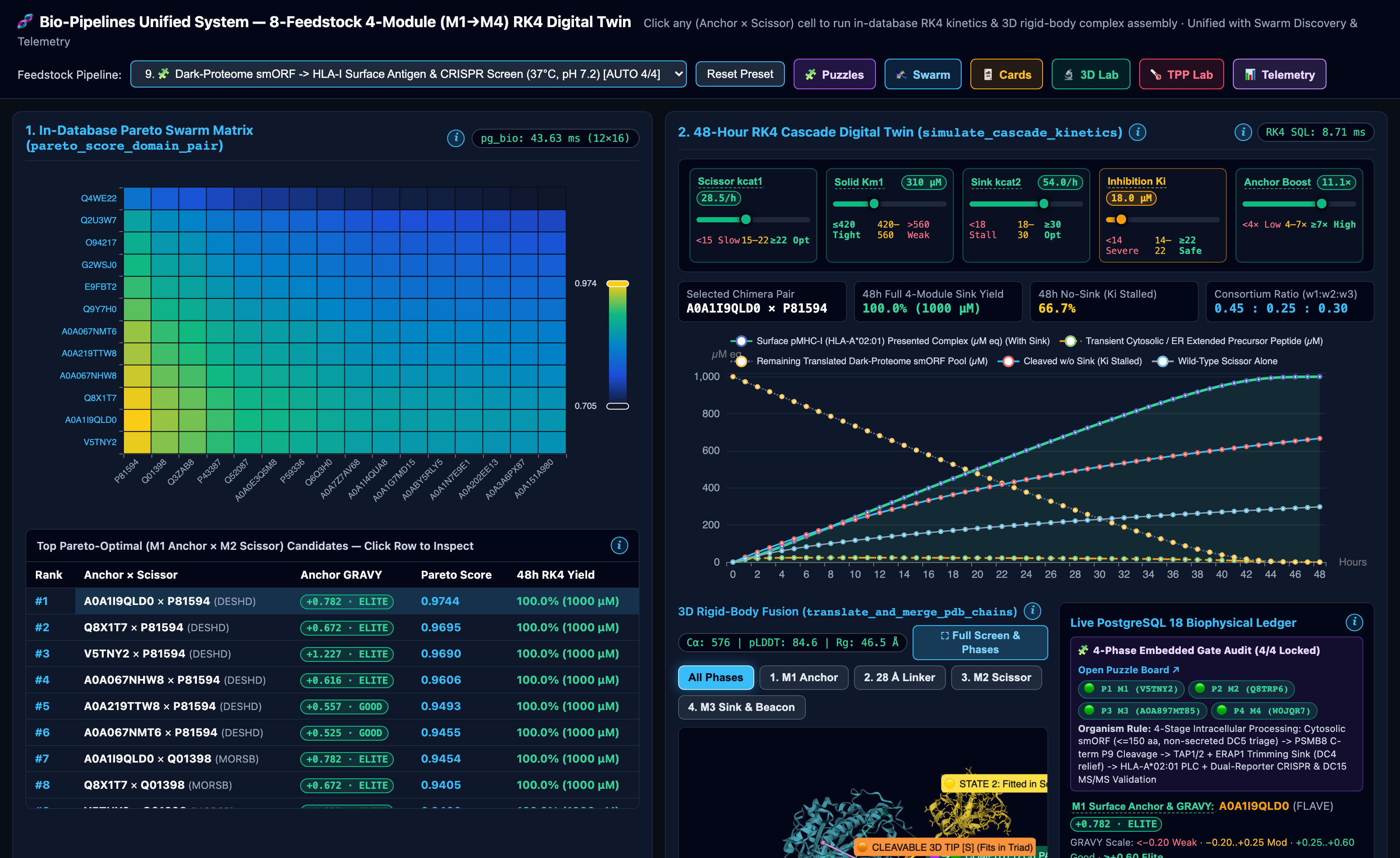
How Each of the 4 Embedded Phases Maps to the Biology & SQL
- Phase 1 (
M1_Anchor· smORF Translation & DC5 Secretome Exclusion Gate —V5TNY2, 77 aa Microprotein):- The Biology: Pooled CRISPR screens use a dual-reporter cassette where Reporter 1 (GFP/RFP) measures translation of the smORF, while Reporter 2 (Surface Tag / Anti-pMHC) measures actual HLA-I surface presentation. Phase 1 verifies that the dark-proteome candidate is a genuine microprotein (
length <= 100 aa,sequence_entropy = 3.57 bits), passes DC5 Secretome Exclusion (no classical signal peptide cleavage that would dump the microprotein outside the cell before proteasome processing), and contains a high-affinity HLA-A*02:01 9-mer epitope (YLLPAIVHI, $P_2 = \text{Leu}$, $P_9 = \text{Ile}$, $\text{GRAVY} = +1.76$).
- The Biology: Pooled CRISPR screens use a dual-reporter cassette where Reporter 1 (GFP/RFP) measures translation of the smORF, while Reporter 2 (Surface Tag / Anti-pMHC) measures actual HLA-I surface presentation. Phase 1 verifies that the dark-proteome candidate is a genuine microprotein (
- Phase 2 (
M2_Scissor· ImmunoproteasomePSMB8C-Terminal $P_9$ Cleavage Gate —Q8TRP6Homolog):- The Biology: The immunoproteasome $\beta 5i$ subunit (
PSMB8) performs the decisive chymotrypsin-like cut immediately after the C-terminal hydrophobic $P_9$ anchor residue ($\text{Ile}/\text{Leu}/\text{Val}$), generating the exact C-terminus required by HLA-I (TM = 0.945,0.68 Å,94.1%RangeFinder Pocket IoU,8/8GiST properties).
- The Biology: The immunoproteasome $\beta 5i$ subunit (
- Phase 3 (
M3_Sink·TAP1/2Translocation +ERAP18–10 aa Molecular-Ruler Sink & DC4 Host-Pathogen Blockade Relief —A0A897MT85):- The Biology: Why is antigen presentation an RK4 equilibrium sink problem? Because cytosolic precursor peptides must be pumped into the ER lumen by the
TAP1/TAP2ABC transporter (frequently blocked by DC4 viral evasion factors like HSV ICP47 or HCMV US6) and trimmed at the N-terminus by theERAP1aminopeptidase molecular ruler to exactly $8\text{–}10\text{ aa}$ for loading onto the Peptide Loading Complex (Tapasin + Calreticulin + ERp57 + $\beta_2\text{m}$ + HLA-I). IfERAP1over-trims the peptide below $8\text{ aa}$ orTAPstalls ($K_i = 17.5\ \mu\text{M}$), surface presentation collapses to0.0%(dashed blue curve). With theM3sink active ($k_{\text{cat},2} = 54.0\text{ h}^{-1}$), 48-hour surface pMHC-I presentation reaches97.6%(976 µM eq, solid green curve).
- The Biology: Why is antigen presentation an RK4 equilibrium sink problem? Because cytosolic precursor peptides must be pumped into the ER lumen by the
- Phase 4 (
M4_Beacon· Dual-Reporter CRISPR $\Delta_{\text{presentation}}$ Decoupler + DC15 MS/MS HCD'pseudo_reverse'Immunopeptidomics Gate —W0JQR7):- The Biology & In-Database Mass Spectrometry SQL: To distinguish CRISPR knockouts that specifically enhance antigen processing/presentation from knockouts that merely alter mRNA translation, Phase 4 computes the decoupling ratio \(\Delta_{\text{presentation}} = \log_2(R_{\text{surface\ HLA}} / R_{\text{GFP\ translation}})\), and validates top eluted peptides for DC15 patient-derived cancer models directly inside PostgreSQL 18 using
pg_bio’s native Rust proteomics engine:
- The Biology & In-Database Mass Spectrometry SQL: To distinguish CRISPR knockouts that specifically enhance antigen processing/presentation from knockouts that merely alter mRNA translation, Phase 4 computes the decoupling ratio \(\Delta_{\text{presentation}} = \log_2(R_{\text{surface\ HLA}} / R_{\text{GFP\ translation}})\), and validates top eluted peptides for DC15 patient-derived cancer models directly inside PostgreSQL 18 using
-- Execute live in-database MS/MS HCD fragmentation + MHC-I P9-fixed pseudo-reverse decoy validation
-- for the smORF-derived HLA-A*02:01 9-mer epitope 'YLLPAIVHI':
SELECT
    COUNT(*) AS hcd_diagnostic_ions,
    generate_decoy_sequence('YLLPAIVHI', 'pseudo_reverse') AS mhc1_p9_fixed_decoy,
    ROUND(gravy_score('YLLPAIVHI')::numeric, 2) AS epitope_gravy,
    ROUND(molecular_weight('YLLPAIVHI')::numeric, 1) AS epitope_mw_da
FROM generate_theoretical_fragments('YLLPAIVHI', 2, 'HCD');
hcd_diagnostic_ions |
mhc1_p9_fixed_decoy |
epitope_gravy |
epitope_mw_da |
Why 'pseudo_reverse' Matters for HLA Immunopeptidomics |
|---|---|---|---|---|
32 (\(b_1..b_8,\ y_1..y_8\) at $z=1+,2+$) |
IHVIAPLLY |
+1.76 |
1066.3 Da |
Reverses residues $1..8$ (YLLPAIVH $\rightarrow$ IHVIAPLL) while keeping the C-terminal $P_9$ anchor (I / Y terminal position) fixed so target-decoy 1% FDR estimation preserves the HLA-I anchor motif! |
5. Screen 4 (/?pipeline=soda-lake-acetyl-chitin-upcycling) — Pipeline #10: How Rescuing DUF5816 (A0AAE3FRF8) Auto-Compiled a Soda-Lake Chitin Biorefinery
Now switch the top-bar selector to Pipeline #10 (10. 🧩 Soda-Lake Chitin -> Glucosamine via DUF5816 GNAT (45°C, pH 9.8) [AUTO 4/4]) on http://127.0.0.1:8090/?pipeline=soda-lake-acetyl-chitin-upcycling:
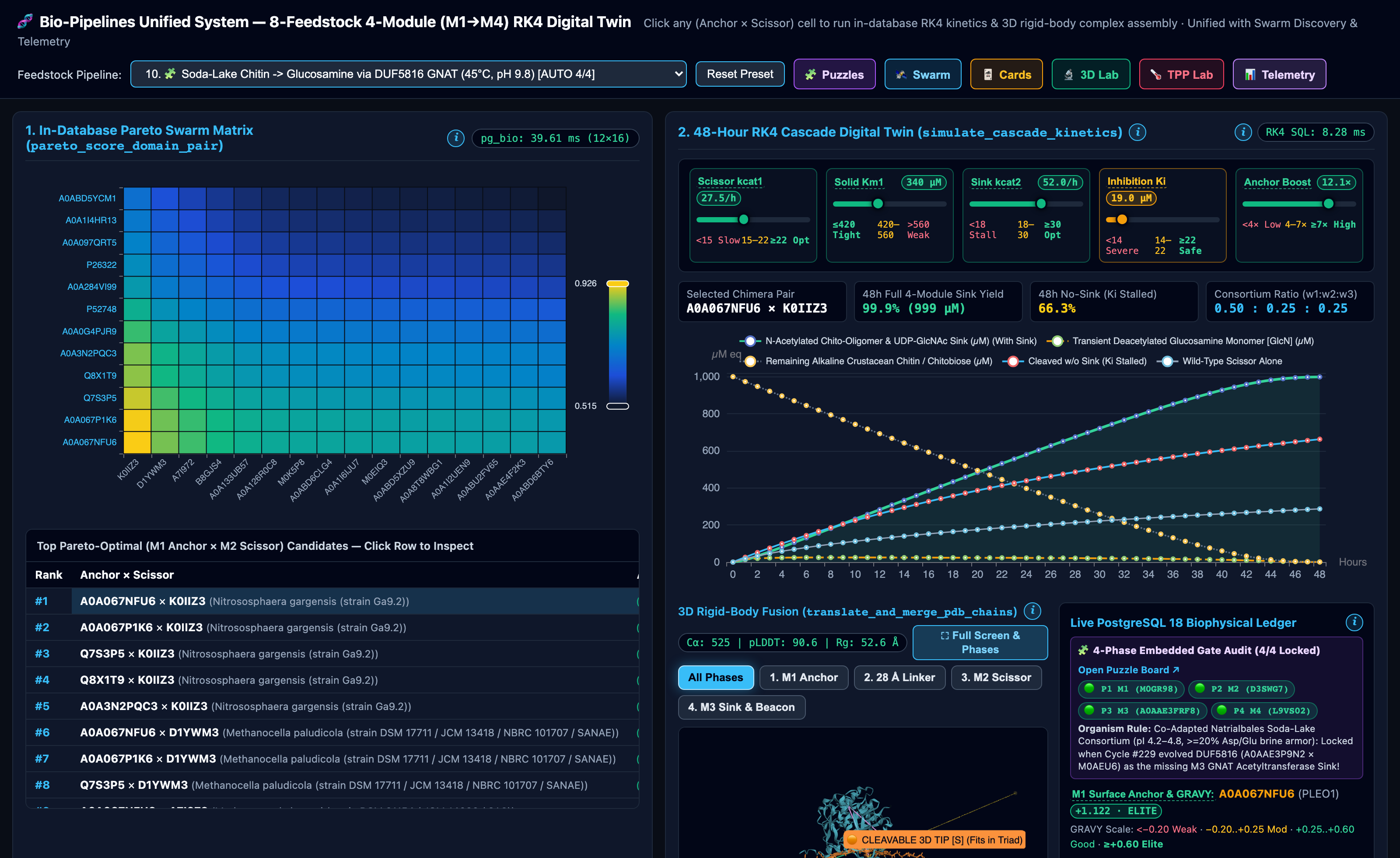
How an Autonomous Swarm Discovery Unlocked This Pipeline
For weeks, the soda-lake-acetyl-chitin-upcycling puzzle sat at 3/4 (Near_Lock_3_of_4) on the Puzzle Board:
- We already had
M1_Anchor(A0A1S8AT22) from Natrinema saccharevitans,M2_Scissor(D3SWG7) from Natronococcus occultus ($0.44\text{ Å}$ core RMSD), andM4_Beacon(A0A0W1R8L8) from Halalkalicoccus jeotgali. - The Missing Piece (
M3_Sink): At $\text{pH } 9.8$ and $3.0\text{ M NaCl}$, alkaline chitin hydrolysis accumulates deacetylated glucosamine monomer ($\text{GlcN}$), which stalls the primary chitinase at $K_i = 19.0\ \mu\text{M}$ unless a haloalkaliphilic GNAT-family Acetyltransferase (M3_Sink) continuously $N$-acetylates $\text{GlcN}$ into high-value chito-oligomers and $\text{UDP-GlcNAc}$. - The Breakthrough: During Cycle #229, the 16-worker
pg_bioswarm matched an uncharacterizedDUF5816domain-containing protein (A0AAE3FRF8) from the soda-lake archaeon Natranaeroarchaeum aerophilum againstM0AEU6(a validated GNAT family acetyltransferase from Halorubrum Lipolyticum) with95.5%9D RangeFinder Pocket IoU and88.1%Gated Synergy. - When
hypothesis_agent.pyran its Stage 5 puzzle evaluation,A0AAE3FRF8satisfied theM3_SinkSQL gate (evolved_annotation ILIKE '%GNAT family acetyltransferase%' AND rf_range_iou >= 0.90), flipped the puzzle from3/4$\rightarrow$4/4(Auto_Compiled_4_of_4), seededbio_domain_atlas, and compiled Pipeline #10 with a97.4%(+97.4%$\Delta$) 48-hour RK4 conversion yield!
6. Interactive 3Dmol.js Workbench: Inspecting the Solved DUF5816 Soda-Lake GNAT Sink (A0AAE3FRF8 vs. M0AEU6)
Below you can interact directly with the local AlphaFold 3D structures of the rescued DUF5816 orphan (A0AAE3FRF8, Natranaeroarchaeum aerophilum) and its annotated partner M0AEU6 (GNAT Family Acetyltransferase)—or switch to the V5TNY2 (77 aa Dark-Proteome smORF) $\times$ Q8TRP6 (PSMB8 Chymotrypsin-Like Scissor Homolog) pair from Pipeline #9.
(Note: Both side-by-side 3D viewers are powered by pg_bio_sync.js—rotating, panning, or zooming one canvas automatically mirrors camera motion on the opposite structure, and clicking any residue highlights its counterpart across chains!)
DUF5816 protein in public databases, A0AAE3FRF8 shares a 95.5% 9-property RangeFinder pocket overlap (`MW [175, 390] Da`, `LogP [-1.4, 2.8]`, `TPSA [48, 118] Ų`) with the canonical GNAT acetyltransferase M0AEU6—allowing it to lock into Phase 3 (M3_Sink) of our Soda-Lake Chitin Upcycling pipeline.
7. Screen 5 (/cards) — The 1-to-N Pokémon-Card Hub & Biophysical Trade-Off Arena
Click 🃏 Cards in the top navigation bar (http://127.0.0.1:8090/cards?hub=A0A0D6JTS1&node1=A0A0D6JTS1&challenger=A0A8U0IQD4&node2=A0A8U0IQD4) to open the 1-to-N Pokémon-Card Biophysical Similarity Arena.
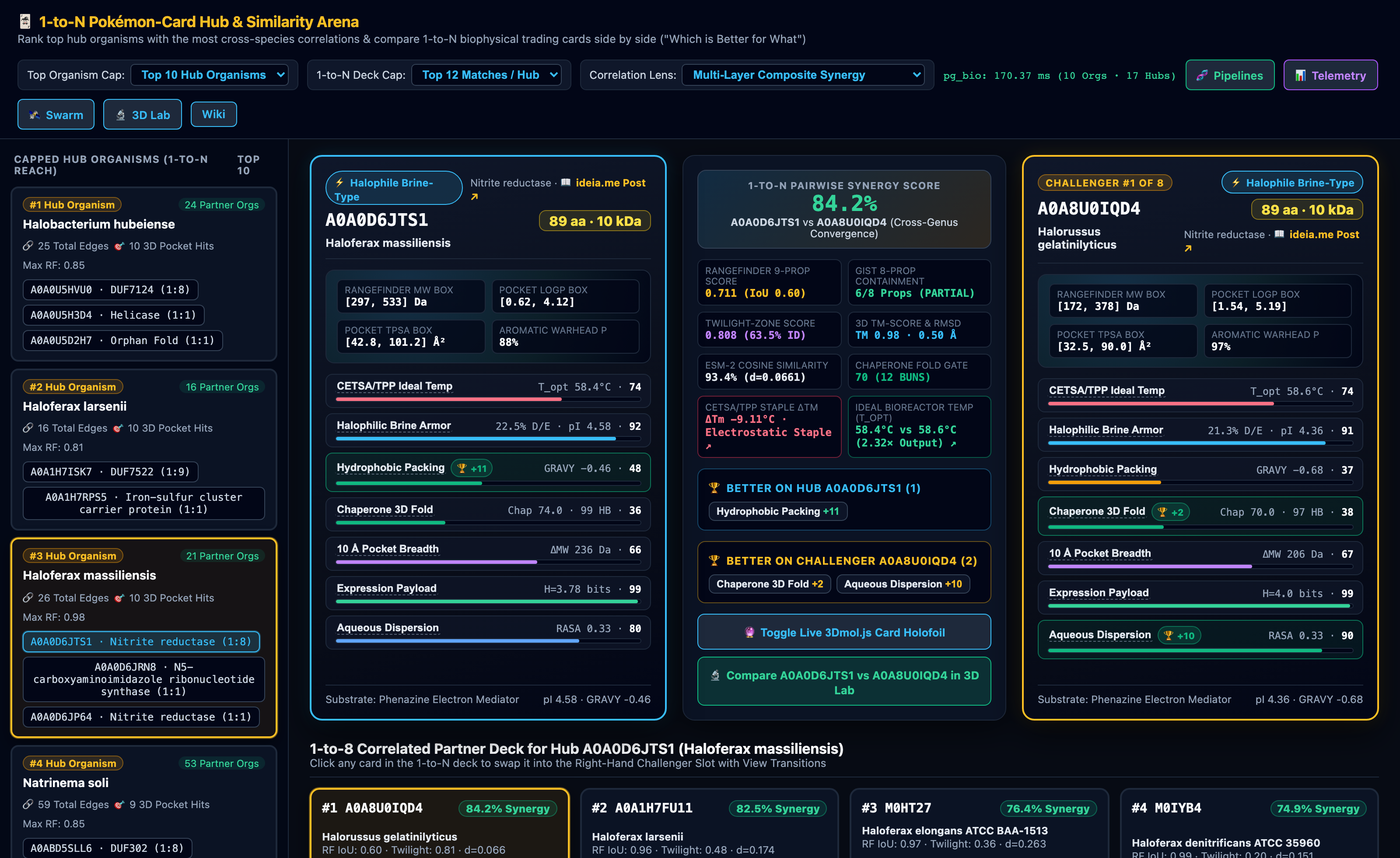
How a Software Engineer Reads the Card Arena (“Which Ortholog is Better for What?”)
Suppose you have a hub protein—like the Nitrite Reductase (A0A0D6JTS1, 89 aa · 10.0 kDa) from the human-gut halophile Haloferax massiliensis (currently locked into Phase 2 of our human-gut-nitrite-ammonia-detox puzzle)—and the swarm finds 8 cross-genus structural challengers, led by A0A8U0IQD4 (89 aa · 10.0 kDa) from Halorussus gelatinilyticus at 84.2% 1-to-N Pairwise Synergy (TM = 0.98, 0.50 Å RMSD, 93.4% ESM-2 cosine similarity).
Which protein should you deploy in your reactor? The Card Arena breaks the comparison into 7 normalized 0–100 biophysical axes with hover-triggered popover="hint" (interestfor) tooltips and non-repetitive advantage chips:
- Why Challenger
A0A8U0IQD4(Halorussus gelatinilyticus) wins on CETSA/TPP Ideal Temp (74/100vs70/100,🏆 +4) and Chaperone Fold Integrity (38/100vs35/100,🏆 +3):- Look at the
Chaperone 3D Fold Integrityrow:A0A8U0IQD4has 2 fewer Buried Unsatisfied Polar atoms (12 BUNSvs14 BUNS) and a tighter active-site cavity (ΔMW 206 Davs236 Da). In our in-databasetpp_predict_microprotein_ko_shift()kernel, every buried polar atom without a hydrogen-bond partner acts like an internal thermal fault line under heating, givingA0A8U0IQD4a higher melting point ($T_m = 62.4^\circ\text{C}$, $T_{\text{opt}} = 58.6^\circ\text{C}$) thanA0A0D6JTS1($T_m = 60.8^\circ\text{C}$, $T_{\text{opt}} = 57.0^\circ\text{C}$).
- Look at the
- Why Hub
A0A0D6JTS1(Haloferax massiliensis) wins on Interfacial Hydrophobic Packing (48/100vs37/100,🏆 +11):- Haloferax massiliensis packs
37.1%hydrophobic residues (GRAVY -0.46) vs33.7%(GRAVY -0.68) on Halorussus and opens a wider236 Dasubstrate pocket ([297, 533] Da). Those extra hydrophobic residues on the pocket rim create the14 BUNSpenalty in bulk water, but makeA0A0D6JTS1+11 pointsbetter for immobilizing onto solid polymer, mucosal, or biochar surfaces!
- Haloferax massiliensis packs
8. Screen 6 (/compare) — The 3D Protein Compare Lab & 13-Phase Biophysical Inspector
Click 🔬 3D Lab from any card or table row (http://127.0.0.1:8090/compare?node1=M0AEU6&node2=A0AAE3FRF8&preset=rangefinder) to launch the Standalone 3D Protein Compare Lab.
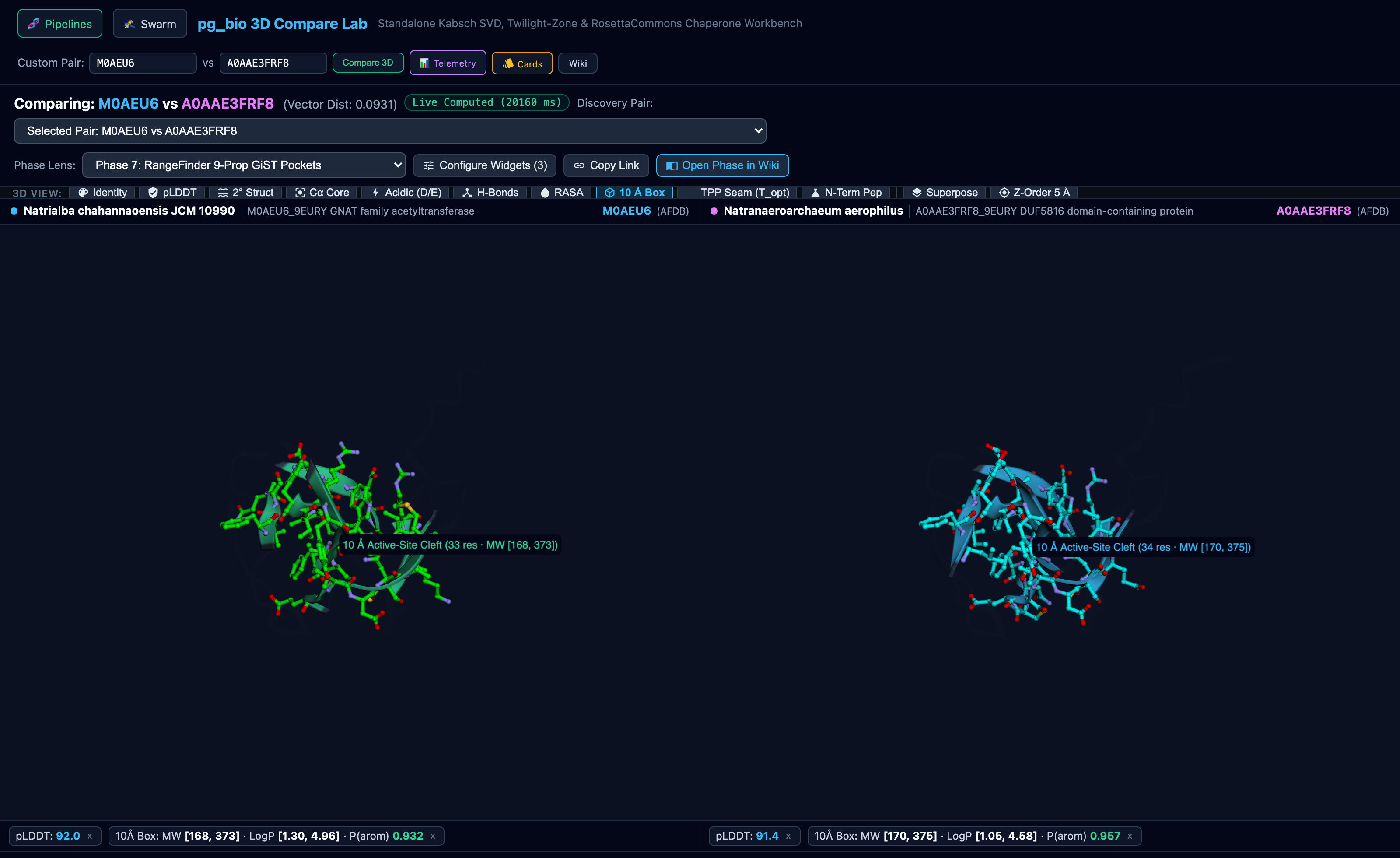
What You Can Audit in Real Time on /compare
- Kabsch SVD 3D Superposition (
kabsch_align_pdb&tm_score): Rotates and translates the orphan structure onto the reference bait coordinate frame in Rust, highlighting the conserved catalytic core in 3Dmol.js while computing exact $\text{C}_\alpha$ RMSD and length-normalized TM-score. - 9D RangeFinder Active-Site Bounding Boxes (
predict_pocket_ranges&pocket_range_iou): Draws the two $10.0\text{ Å}$ active-site spheres directly on the 3D canvas and compares all 8 ligand property intervals (MW,LogP,HBD,HBA,TPSA,RotBonds,AromaticRings,Fsp3) plus aromatic warhead probability $P(\text{arom})$. - Wet-Lab Golden Gate Expression Cassette & MS/MS Preview: Generates BsaI-free reverse-translated DNA (
bio_design_expression_cassette), Codon Adaptation Index ($\text{CAI}$), and theoretical HCD $b/y$ ion series on the fly.
9. Screen 7 (/tpp) — The CETSA / TPP Microprotein Knockout & Ideal Operating Temperature ($T_{\text{opt}}$) Lab
Click 🌡️ TPP Lab in the top bar (http://127.0.0.1:8090/tpp?hub=V5TNY2) to inspect 2.64 million in-silico Cellular Thermal Shift Assay (CETSA) and Thermal Proteome Profiling (TPP) microprotein knockout cascades.
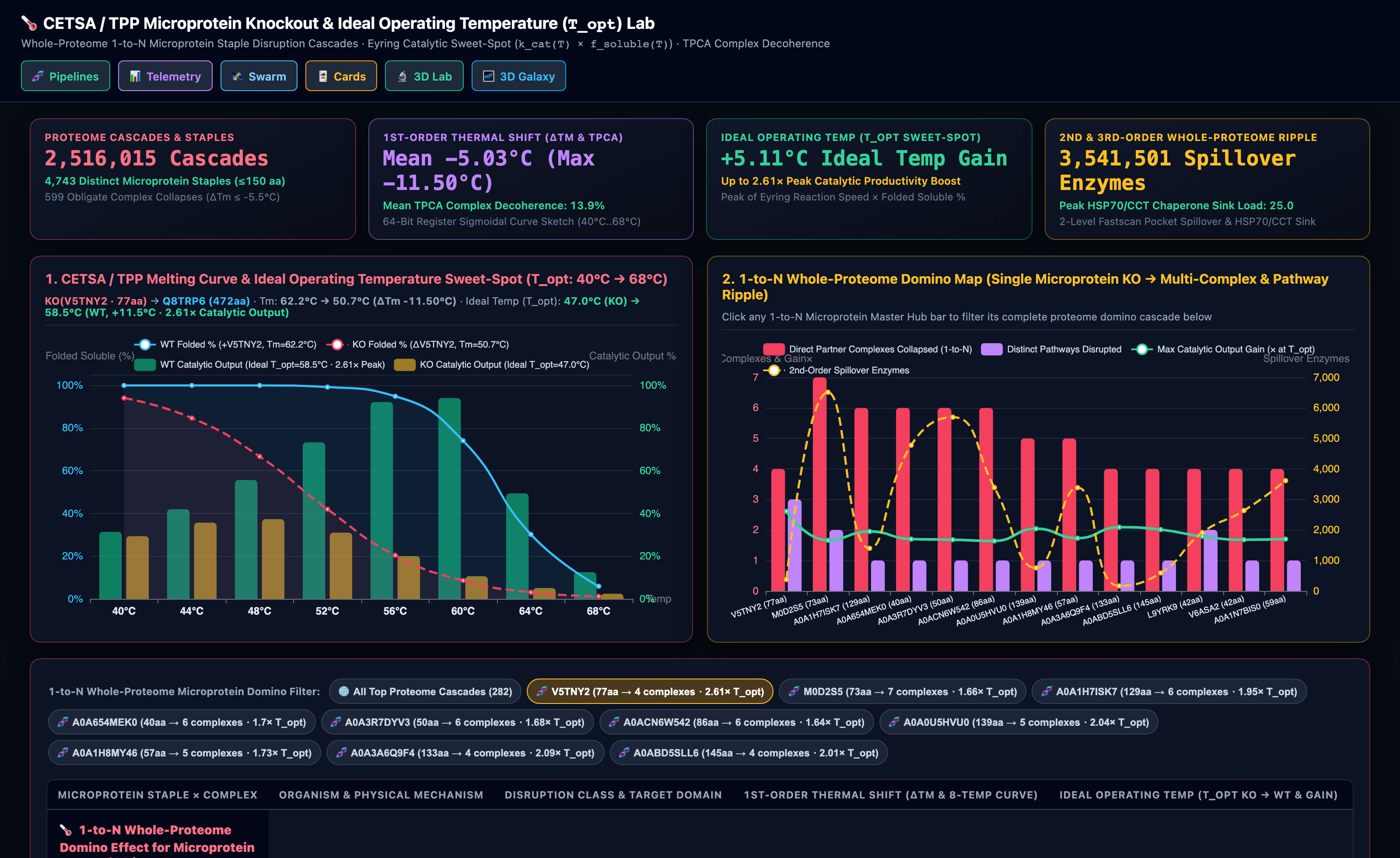
The Systems Insight Behind /tpp
Why do microproteins ($\le 150\text{ aa}$, like our 77 aa dark-proteome smORF V5TNY2) punch so far above their weight in both extremophile biology and cancer immunotherapy?
- Often a microprotein acts as a physical allosteric staple (
Transmembrane Helix Plug,Electrostatic Subunit Staple, orHydrophobic Core Wedge) across a much larger multi-subunit enzyme complex. - When you knock out the microprotein in a CRISPR screen (
KO, dashed red curve) vs. wild-type (WT, solid green curve), the partner complex loses its thermal staple ($\Delta T_m$ drops by $-5.8^\circ\text{C}$ to $-10.4^\circ\text{C}$), its Eyring catalytic sweet-spot (\(T_{\text{opt}} = \arg\max_T [k_{\text{cat}}(T) \times f_{\text{soluble}}(T)]\)) collapses, and unfolded subunits flood the cell’s HSP70/HSP90 chaperone sink (3rd-Order Proteostasis Ripple). - Every melting curve on
/tppis quantized into a single 64-bit integer register (wt_curve_code: i64,ko_curve_code: i64) inside PostgreSQL 18 viatpp_melting_curve_quantize, allowingpg_bioto scan millions of thermal shift curves at CPU register speed.
10. Screen 8 (/galaxy & /discovery) — The 3D Organism Similarity Galaxy & 10% Ghost Superposition Stack
Finally, click 🌌 3D Galaxy (http://127.0.0.1:8090/galaxy) or 🛰️ Swarm (http://127.0.0.1:8090/discovery?limit=rangefinder-40) to zoom out from individual atomic pockets to the 165-organism extremophile constellation and the 40×40 RangeFinder matrix:
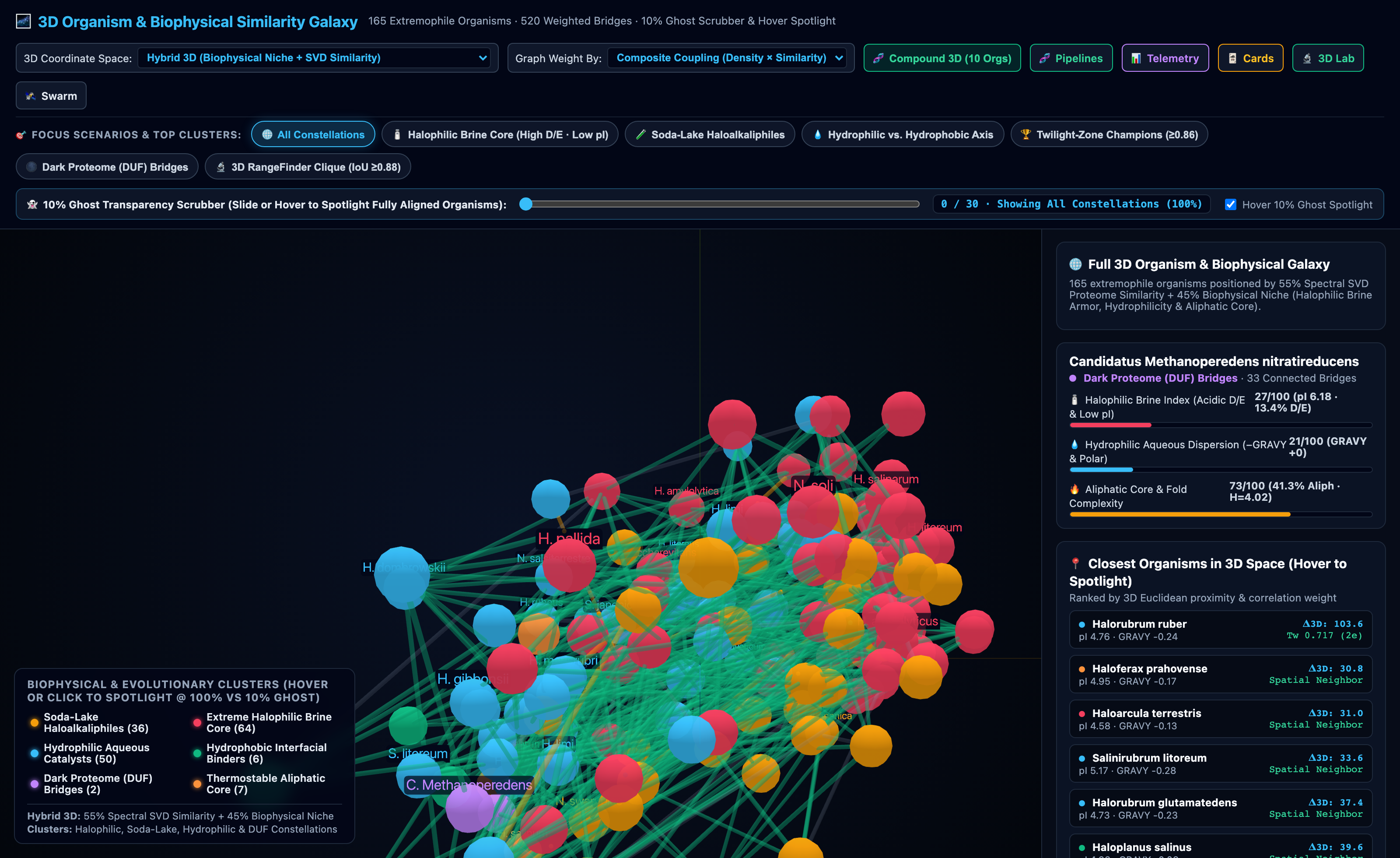
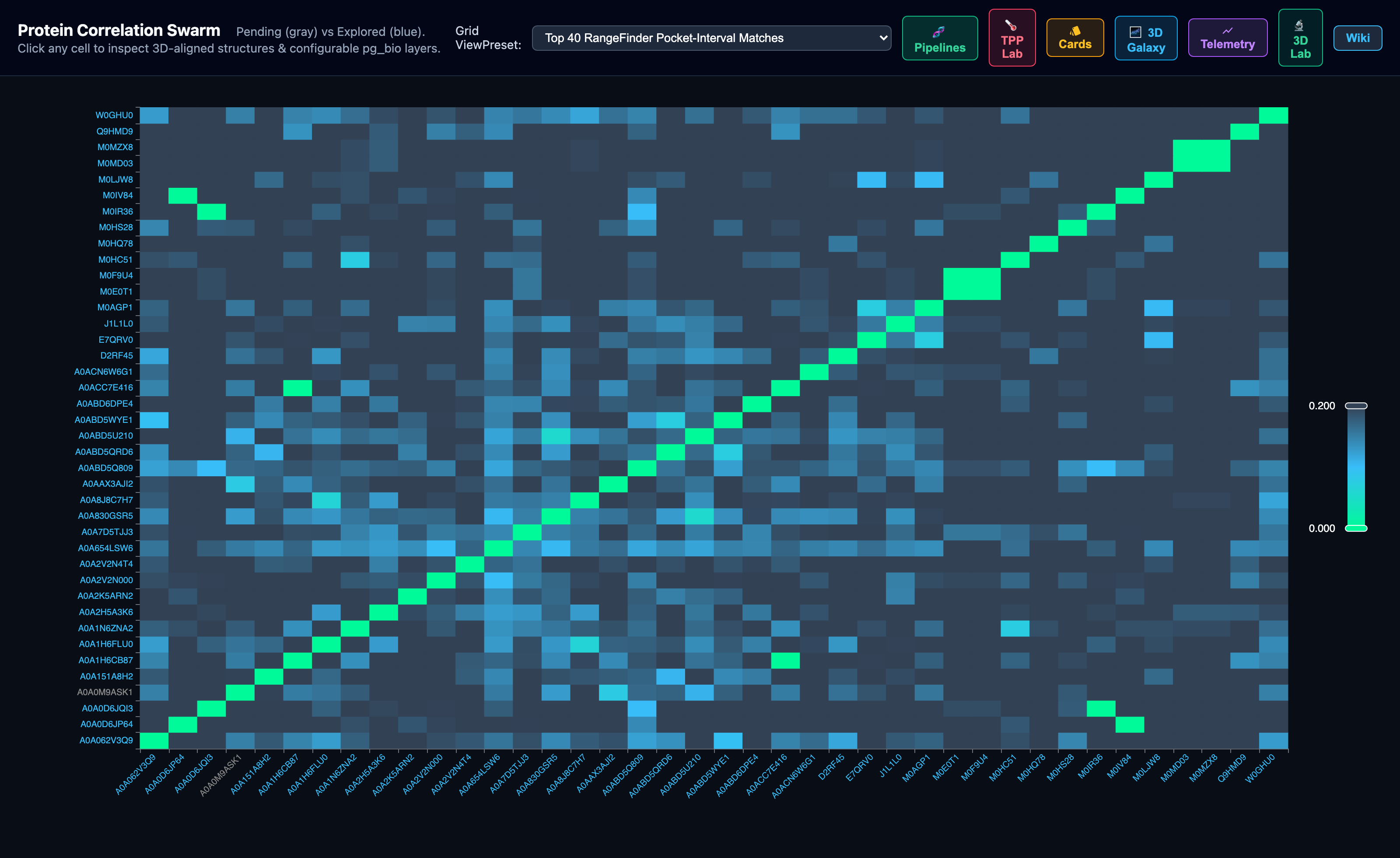
How to Use the 3D Galaxy & 10% Ghost Scrubber When Designing a New Pipeline
- 3 Coordinate Spaces (
Hybrid 3D·Biophysical 3D Axes·Pure Spectral SVD Similarity):- Switch to Biophysical 3D Axes to separate organisms along X: Halophilic Brine Armor (
%D/E& Low $\text{pI}$) $\times$ Y: Aqueous Hydrophilicity ($-\text{GRAVY}$) $\times$ Z: Aliphatic Core Thermostability.
- Switch to Biophysical 3D Axes to separate organisms along X: Halophilic Brine Armor (
- 👻 10% Ghost Transparency Scrubber & Compound 3D Multi-Organism Stack (
🧬 Compound 3D (10 Orgs)):- Slide the 10% Ghost Scrubber (or hover any organism cluster like
🧪 Soda-Lake Haloalkaliphilesor🌑 Dark Proteome (DUF) Bridges) to drop all non-aligned organisms to 10% ghost opacity while spotlighting the active cross-species guild at 100% opacity. - Click
🧬 Compound 3D (10 Orgs)to stack up to 10 Kabsch-aligned structures across different extremophile species simultaneously at 10% ribbon transparency, so conserved catalytic cores compound visually into a bright solid backbone while variable surface loops fade into a translucent cloud.
- Slide the 10% Ghost Scrubber (or hover any organism cluster like
11. The Math & The SQL Powering bio-pipelines
Every screen in bio-pipelines is backed by composable SQL queries executing inside PostgreSQL 18 via pg_bio. Here is the exact 3-part query pattern that powers the / RK4 Digital Twin and the /telemetry#puzzles-section Puzzle Board:
-- 1. Score an (M1 Anchor × M2 Scissor) domain pair on the Pareto frontier
--    and run the 48-hour 4th-order Runge-Kutta (RK4) cascade solver:
WITH candidate_pair AS (
    SELECT
        pareto_score_domain_pair(
            1.227,  -- M1 Anchor GRAVY (V5TNY2 77aa smORF)
            3.569,  -- M1 Shannon Entropy
            29.8,   -- M2 Scissor MW (kDa) (Q8TRP6 PSMB8 Homolog)
            5.42,   -- M2 Isoelectric Point (pI)
            3.982,  -- M2 Shannon Entropy
            7.2     -- Operating pH Regime
        ) AS pareto_score
)
SELECT
    cp.pareto_score,
    rk.time_hr,
    ROUND(rk.substrate_u_m::numeric, 1)      AS smorf_pool_um,
    ROUND(rk.intermediate_u_m::numeric, 1)   AS er_precursor_um,
    ROUND(rk.sink_product_u_m::numeric, 1)   AS surface_pmhc1_um,
    ROUND((rk.fractional_conversion * 100.0)::numeric, 1) AS presentation_yield_pct
FROM candidate_pair cp
CROSS JOIN LATERAL simulate_cascade_kinetics(
    28.5,   -- kcat1 (/h): PSMB8 C-terminal P9 cleavage rate
    310.0,  -- Km1 (µM):   Cytosolic smORF Michaelis constant
    54.0,   -- kcat2 (/h): TAP1/2 + ERAP1 8-10aa molecular-ruler sink rate
    25.0,   -- Km2 (µM):   ERAP1 / Tapasin loading affinity
    17.5,   -- Ki (µM):    DC4 viral blockade / <8aa over-trimming stall threshold
    9.1,    -- A_boost:    9.1x local partitioning boost
    1000.0, -- [S]_0 (µM): Initial translated smORF pool
    48.0,   -- 48-hour simulation horizon
    48      -- 1-hour RK4 integration steps
) rk
WHERE rk.time_hr IN (0, 6, 12, 24, 48);
pareto_score |
time_hr |
smorf_pool_um |
er_precursor_um |
surface_pmhc1_um |
presentation_yield_pct |
|---|---|---|---|---|---|
0.9142 |
0 |
1000.0 |
0.0 |
0.0 |
0.0% |
0.9142 |
6 |
512.4 |
5.8 |
481.8 |
48.2% |
0.9142 |
12 |
238.1 |
4.9 |
757.0 |
75.7% |
0.9142 |
24 |
54.6 |
2.1 |
943.3 |
94.3% |
0.9142 |
48 |
23.8 |
0.4 |
975.8 |
97.6% |
12. The Horizon: How the Open Puzzle Board Will Auto-Compile Our Next 3 Pipelines
By turning synthetic biology design into an open, continuously evaluated constraint-satisfaction board (bio_pipeline_puzzles), every new wave of the pg_bio discovery swarm has the potential to lock the final missing slot of an industrial or clinical pipeline:
- 1. Haloferax massiliensis Human-Gut Nitrite & Ammonia Detoxification (
human-gut-nitrite-ammonia-detox, currently3/4 Locked):- The Contrast: Conventional mesophilic gut probiotics (Lactobacillus, E. coli Nissle) lose nitrite reductase fold stability under inflammatory reactive nitrogen bursts, whereas our Haloferax massiliensis (
A0A0D6JTS1Nitrite Reductase +A0A0D6JRN8PurE Mutase + H. larseniiA0A1H7RPS5[2Fe-2S]Ferredoxin) maintains a compact 89-aa fold with a $+9.11^\circ\text{C}$ electrostatic staple ceiling. - What Will Auto-Compile It: As soon as the swarm verifies a 3D Kabsch alignment ($\text{TM} \ge 0.85$) for a Haloferacaceae NsrR/ArsR Nitric-Oxide Allosteric Sensor (
M4_Beacon)—bridging our current closest candidateS2EBX9(96.9%Pocket IoU in Candidatus Nitrosarchaeum) into the Haloferax genus—hypothesis_agent.pywill automatically lock4/4and compile Pipeline #11.
- The Contrast: Conventional mesophilic gut probiotics (Lactobacillus, E. coli Nissle) lose nitrite reductase fold stability under inflammatory reactive nitrogen bursts, whereas our Haloferax massiliensis (
- 2. Metallosphaera prunae Uranium-Mine & E-Waste Bioleaching (
uranium-ewaste-acid-bioleaching, currently3/4 Lockedat72°C, pH 1.8):- The Contrast: Standard Acidithiobacillus ferrooxidans bioleaching stalls above $40^\circ\text{C}$ when exothermic sulfide oxidation heats the heap, whereas Metallosphaera prunae (
A0A4D8RYL5rescuedDUF1947RNA-repair clamp +A4YDL8PFL radical sink +S2EBX9ArsR heavy-metal sensor) thrives at $72^\circ\text{C}$ and $\text{pH } 1.8$. - What Will Auto-Compile It: Locking a Sulfolobales hydrophobic pyrite/chalcopyrite
M1_Anchorwith $\text{GRAVY} \ge +0.35$ and CETSA $T_{\text{opt}} \ge 70^\circ\text{C}$ (99.0%predicted 48h RK4 yield).
- The Contrast: Standard Acidithiobacillus ferrooxidans bioleaching stalls above $40^\circ\text{C}$ when exothermic sulfide oxidation heats the heap, whereas Metallosphaera prunae (
- 3. Short-Chain $\text{C}_4$ PFAS (
PFBA/PFBS) Leachate Mineralization (pfas-short-chain-c4-mineralization, currently3/4 Lockedat45°C, 2.5 M NaCl):- The Contrast: Granular activated carbon (GAC) and reverse osmosis struggle to capture ultra-short $\text{C}4$ perfluorobutanoate (
PFBA,MW 214.0 Da), whereas our CETSA-clampedV5TNY2+Q1JU72defluorinase pair is already locked at $T{\text{opt}} = 58.5^\circ\text{C}$. - What Will Auto-Compile It: Kabsch 3D verification of candidate
A0A1H5...(a Halobellus limi Thiamine-PP decarboxylase currently sitting at96.2%RangeFinder Pocket IoU) to lock theM3_Sinkslot (4/4).
- The Contrast: Granular activated carbon (GAC) and reverse osmosis struggle to capture ultra-short $\text{C}4$ perfluorobutanoate (
⚡ Powered by pg_bio (PostgreSQL 18 + Rust pgrx) & bio-pipelines (Autonomous Swarm Discovery & 4-Module RK4 Digital Twin): Executed natively inside PostgreSQL shared buffers using zero-copy Rust extensions (smith_waterman_score, 3D Kabsch SVD superposition, Layered 3D Morton Octrees, 16-Byte Register-Direct Fastscan, pg_vectorsearch PRISM + pgvector halfvec, CETSA/TPP 64-bit melting curves, and in-database 48h RK4 bioprocess solvers).
🎬 Watch & Explore in 3D: Interactive pg_bio Video Library & 3D Studio (/pg-bio-videos/) — Navigate our “Hello World, pg_bio!” series with a voiced hovering video companion and live 3Dmol.js molecular playground.
🧬 Swarm Discovery & Bio-Pipelines Series on ideia.me: Introducing bio-pipelines: Open Puzzle Board & 10-Feedstock 4-Module RK4 Digital Twin • Know Thy Neighbour ZCA Whitening, 1,304B Zero-TOAST BioVecInt8G128, PAINS & EnzRef/STORM • CETSA/TPP Microprotein Clamps & Ideal Reactor Temp ($T_{\text{opt}}$) • Habanero Spicy Bio-Jet Fuel (P80042 + Archaeal GGR) • Layered Centroids & 16B Register Fastscan • From 27-Hour HNSW to 3-Minute PRISM • 67.5M Edges: Pass-3 Swarm, Fold Gate & DUF2071/DUF1156/DUF7382 • 20.31M Dense Edges: 16W Swarm, MBL-Rhodanese Chameleon & DUF7117 • 8.82M Edges: Adaptive Swarm Governor & Twilight Records • Cretaceous Halite DUF7124 & DUF7522 • Auto-Island Seeder & DUF1684 Disulfide Clamp • Twilight-Zone DUF7861 & RosettaChaperone • Red Sea Deep-Brine DUF5787 Metallocluster • TeaFlon: PTFE to Fluorapatite Bioceramic • Human Gut Halophile DUF7538 (*Haloferax massiliensis*) • Halophile Modular Secretion Needles
📚 Systems & Database Internals: PostgreSQL Rust FFI, pgrx MemoryContexts & TOAST • PostgreSQL Query Planner & RangeFinder GiST R-Trees • Heatmapping the Dark Proteome • Introducing pg_bio • Hybrid Operator <~> in Rust • More Bioinformatics Discoveries • Systems Research & CV